Quenchant / High-chromium cast iron

AR-HCCI water-based quenchant

Replace a single air-cooling path with a controllable response that aligns high-temperature cooling, low-temperature stress control and HCCI transformation.

Measured cooling data

Four conditions. Compare any combination.

Select any one to four conditions. Each selection controls both paths for that condition—the temperature–time path and the cooling-rate–temperature path—together with its table row. All four are visible by default.

i
Historical test conditions and the current working condition are shown separately

The measured conditions are air at room temperature 30°C; quenchant at 30°C and 50°C with a test ratio of 1:5; and quenchant at 90°C with concentration not stated. Current production uses 1:4.

Combined dual-horizontal-axis cooling chart

The vertical axis is workpiece temperature; the bottom axis is cooling time; the top axis is instantaneous cooling rate at the corresponding temperature.

Bottom axis · Temperature–time pathTop axis · Rate–temperature path
4/4 conditions shown

Measured values

Selecting a condition above updates both curves and its table row.

ConditionCharacteristic
temperature / °C
Characteristic
time / s
Temperature at
max rate / °C
Maximum rate
°C·s⁻¹
V300
°C·s⁻¹
t600
s
t400
s
t300
s
t200
s
Air / room 30°C8490.078289.82.730.066.295.7137.9
Quenchant 30°C / test ratio 1:58201.4679516.86.117.740.455.382.9
Quenchant 50°C / test ratio 1:58280.0981415.45.818.442.860.085.8
Quenchant 90°C / concentration not stated8290.0582311.83.623.854.577.4120.0
High-temperature region / company measuredMaximum rates were 16.8 and 15.4°C/s for quenchant at 30°C and 50°C, versus 9.8°C/s for air.

Under the measured conditions, the quenchant records show stronger cooling in the high-temperature stage.

Around 300°C / company measuredV300 was 3.6°C/s for quenchant at 90°C and 2.7°C/s for air.

At the same reference temperature, the 30°C and 50°C quenchant records were 6.1 and 5.8°C/s, showing bath temperature as an important process variable for the low-temperature response.

Material

High-chromium cast-iron wear castings; the actual grade and chemistry are reviewed for each project.

Workpiece

Balls, liners and other HCCI castings are assessed by effective section, geometric complexity and loading.

Target

Cooling is designed around the required microstructure, hardness, toughness, residual stress and distortion.

Current working mix

Use 1 part AR-HCCI concentrate with 4 parts water. Bath temperature, relative motion, tank capacity and load still determine the actual response.

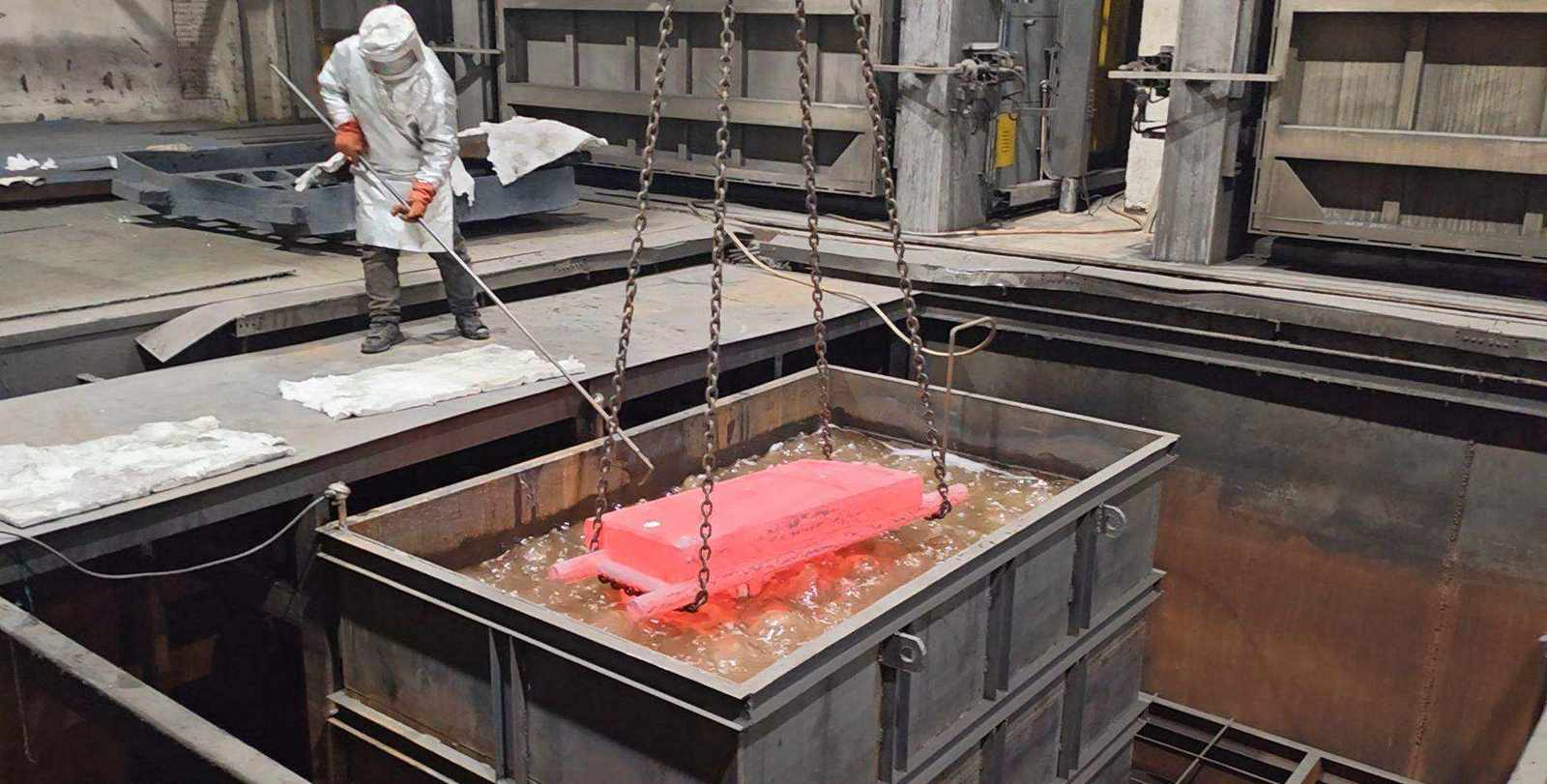
AR-HCCI water-based quenchant in industrial use
Company measured

What these measured values establish

The four unique conditions are air cooling and quenchant at 30°C, 50°C and 90°C. Temperature–time paths, rate–temperature paths and measured indicators are presented together for direct comparison.

Historical test conditions and the current process are labelled separately

The 30°C and 50°C tests used a 1:5 ratio; concentration is not stated for the 90°C record. Current application uses 1 part concentrate to 4 parts water.

Validation

From measured curves to a production window

01

Material & target

Provide chemistry, as-cast structure, dimensions, target microstructure/hardness and acceptance method.

02

Prepare at 1:4

Mix 1 part concentrate with 4 parts water, then record bath temperature, relative motion.

03

Coupon or first article

Confirm structure, hardness, cracking and distortion on a representative coupon or first article.

04

Freeze production

Fix bath temperature, relative motion, loading, transfer time and bath-maintenance requirements.

FAQ

HCCI quenchant data and use

Answers use the company-measured conditions and the current 1:4 working requirement.

How is AR-HCCI mixed for current use?

Use a 1:4 ratio: 1 part AR-HCCI concentrate plus 4 parts water. Bath temperature, relative motion, load and transfer time must still be recorded and controlled.

What are the four curves on this page?

They are company-measured cooling records for air at room temperature 30°C and quenchant at 30°C, 50°C and 90°C. The 30°C and 50°C tests used a 1:5 ratio; the 90°C record does not state concentration. Current production uses 1:4.

Measured data + production footage

Curves show medium response; footage shows production execution

The measured curves above show the cooling response under four report conditions. The production footage below shows real furnace exit, lifting, transfer and preparation for immersion of high-chromium cast-iron hammers. Together they connect medium response with shop-floor practice.

High-chromium hammers: furnace exit and transfer

Watch the fixture, part spacing, lifting attitude and transfer sequence. Current production uses the 1:4 mix while bath temperature, circulation, load and transfer time are controlled.

This is real production footage, but it is not presented as the same test batch as the cooling-characteristic reports above. The curves describe medium response; the video describes production actions and timing.

Send the HCCI chemistry, drawing and current heat-treatment problem

Send the material grade, dimensions/mass, target properties and current problem. We respond across quenchant, fixture, measurement and process layers.