Material
Medium- and high-carbon Cr-Mo steels and related large-section materials; actual chemistry and hardenability data are required.
SAG-mill liners are one application, not the product boundary. The central problem is section size, hardenability, transformation window and cooling uniformity in large Cr-Mo workpieces.
Medium- and high-carbon Cr-Mo steels and related large-section materials; actual chemistry and hardenability data are required.
Large liners, castings, forgings and heavy sections; geometry, section change and loading govern risk.
Quenching or accelerated-normalizing targets may be evaluated, but not without CCT/TTT, furnace and transfer conditions.
Cooling curves, internal temperature, first-article microstructure, hardness and distortion should share one batch record.
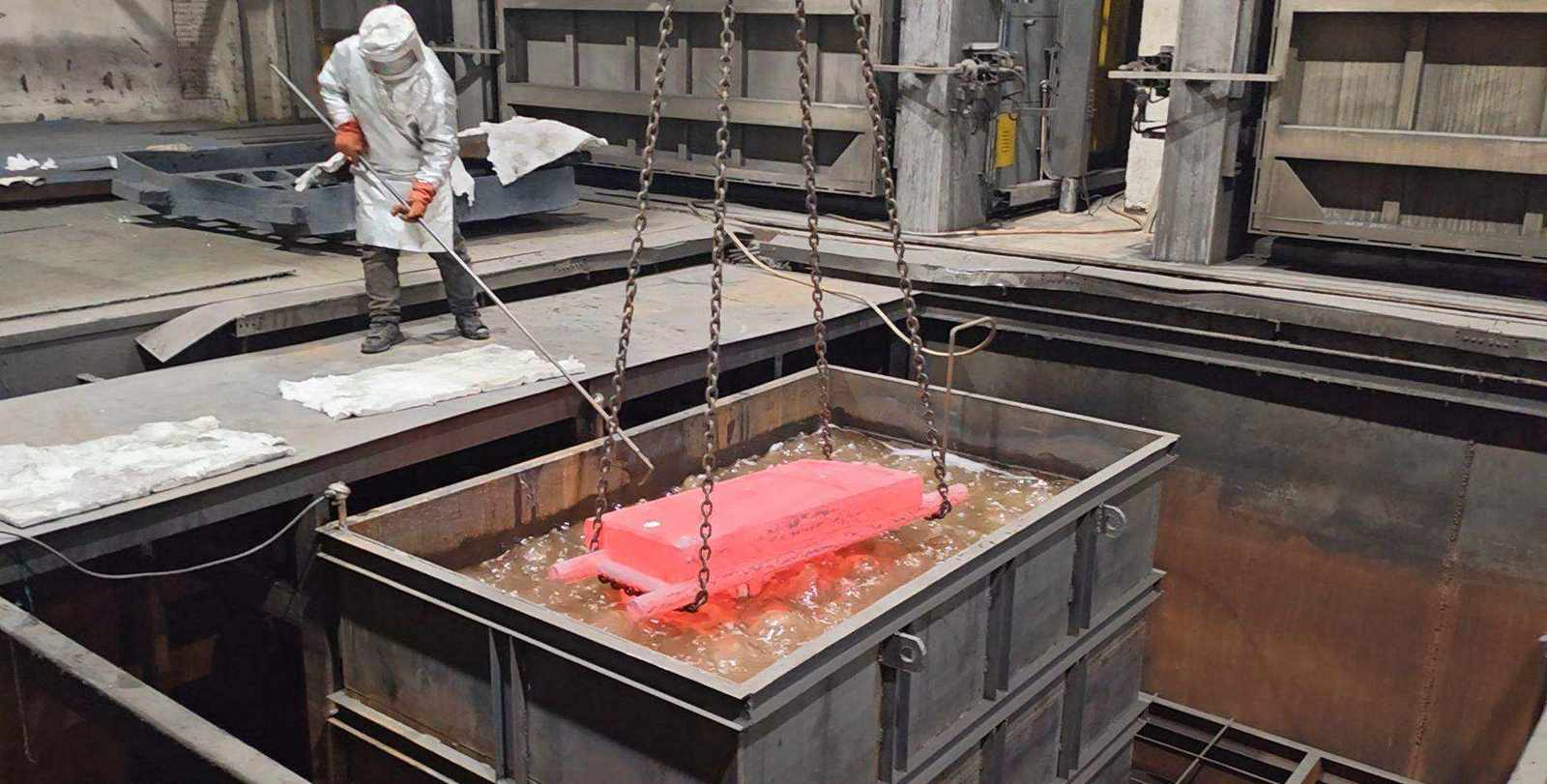
Current material supports large Cr-Mo and SAG-liner applications, but no traceable report was located for universal crack-rate, life or cost-reduction claims. The page therefore states application boundaries and validation methods only.
Web values and curves apply only to the stated sample, probe, method and condition. They are not a guarantee of microstructure, hardness, distortion or crack-free results for a specific workpiece.
Use actual chemistry, CCT/TTT, section and target microstructure to define the required cooling path.
Confirm furnace uniformity, transfer, tank capacity, relative motion and heat rejection.
Adjust the medium window, support/loading and flow together instead of assigning every problem to formulation.
Correct the process with internal temperature, hardness profile, microstructure, NDT and dimensional results.
Answers are bounded by the material, workpiece, equipment and stated test conditions.
No. SAG liners are one application. The engineering boundary is large medium/high-carbon Cr-Mo workpieces with defined section, hardenability, transformation and cooling-uniformity requirements.
Confirm chemistry, CCT/TTT or hardenability data, section and drawing, target properties, furnace uniformity, transfer, tank capacity, relative motion, fixture and inspection plan.
The footage puts workpiece size, load density, fixture support, transfer and tank response in one production context. It helps identify engineering boundaries; it does not replace material and first-article data.
Shows grouped lifting, immersion attitude and bath response for large liners. Material, concentration, process and inspection results remain project-specific.
Shows fixture support, complete-load transfer and immersion. It explains equipment, loading and flow constraints; it is not a material-grade or performance claim.
Both clips are production examples. AR-SAG applicability still depends on actual chemistry, section, CCT/TTT, tank capability and first-article inspection.
Send the material grade, dimensions/mass, target properties and current problem. We respond across quenchant, fixture, measurement and process layers.