Workpiece
Complete drawing, dimensions, mass, weak zones, datums and allowable distortion.
A fixture is more than a lifting frame. It affects support restraint, immersion attitude, air release, cooling flow, transfer safety and final distortion.
Complete drawing, dimensions, mass, weak zones, datums and allowable distortion.
Furnace, loading, heating, extraction, transfer, immersion and removal.
Medium, tank, relative motion, heat exchanger and load density.
Safety factor, repeat location, dimensions, structure/hardness uniformity and maintenance.
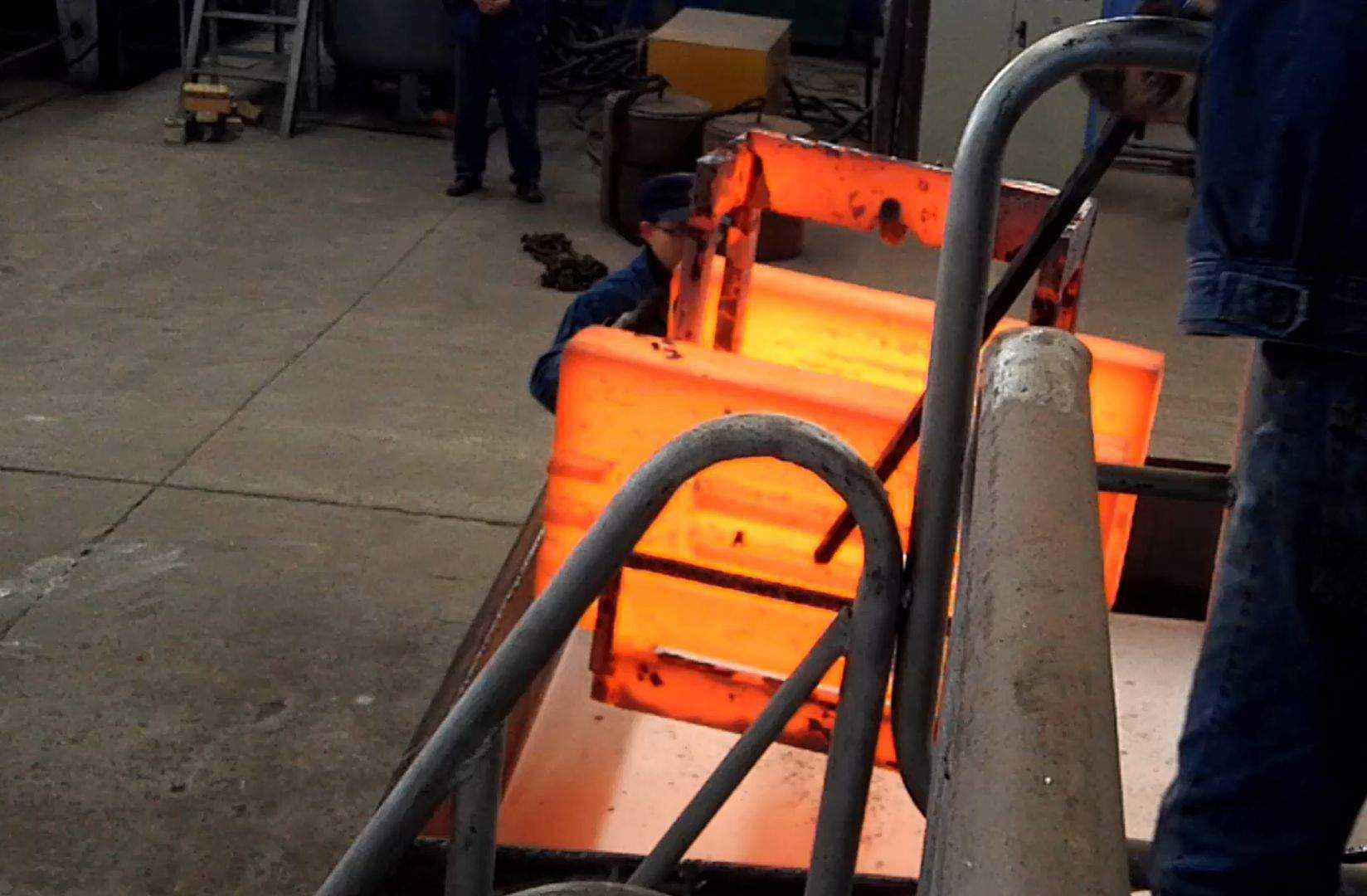
Without load, temperature, medium, life and manufacturing conditions, 316L, Inconel, nozzle angle or load capacity cannot be specified responsibly. Material, joining, thermal expansion, strength, oxidation resistance and cooling channels are determined through project calculation and manufacturing validation.
Web values and curves apply only to the stated sample, probe, method and condition. They are not a guarantee of microstructure, hardness, distortion or crack-free results for a specific workpiece.
Mark distortion-sensitive zones, lift points, supports, air pockets and cooling shadows.
Define location, restraint, lifting attitude, channels and tank interface.
Confirm material/joining, static load and transfer, then conduct a dry fit.
Correct support and flow using temperature, hardness, structure and dimensional results.
Answers are bounded by the material, workpiece, equipment and stated test conditions.
No. Load, temperature, medium, life, joining, thermal expansion, oxidation and manufacturing conditions must be known before material and structure are fixed.
Send the complete drawing, dimensions and mass, weak zones and datums, furnace and transfer route, medium and tank, loading, allowable distortion and acceptance requirements.
Send the material grade, dimensions/mass, target properties and current problem. We respond across quenchant, fixture, measurement and process layers.